Do You Know How Selfies Are Made on Mars?
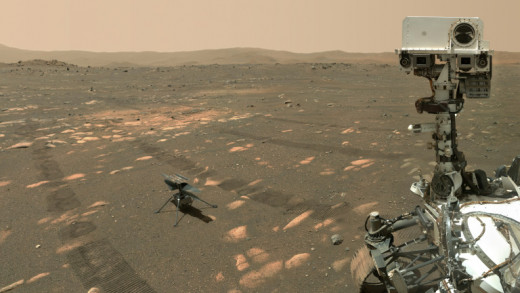 |
Selfie rover Perseverance and helicopter Ingenuity (Photo: NASA)
When people on Earth take a selfie it is a very simple process. They take their smartphone out of their pocket, turn on the camera app, point the smartphone, take a pose, and click. But do you know what it looks like when a selfie is taken on a completely different planet where there is not a single man nearby?
The photos that NASA's rover Perseverance sends to Earth from Mars look impressive, and the photo of the selfie of the rover and the small Ingenuity helicopter caused special enthusiasm. The NASA team decided to find out how that photo came about and how complicated it really is to take a selfie thousands of miles away.
First of all, why does a rover take a selfie at all? In addition to having his own social media profile (yes he is an influencer too), selfies allow a team on Earth to check the status of the rover itself and its immediate environment.
The first selfie on Mars was taken on October 31, 2012 and was taken by NASA’s first rover on Mars, Sojourner. In the meantime, the technique with which selfies are made on Mars, but also the technology with which they are made, have advanced. So NASA released a video showing Perseverance pulling out and twisting his robotic arm to take 62 photos from which one selfie was ultimately taken.
But what is not seen is how complicated the whole process actually is. Just like with professional influencers on Earth, Perseverance's selfie required not just one person but a whole team - from rover drivers, systems engineers, camera engineers, photo-processing experts and gluing them together to those who monitor it all. and coordinate.
In addition to needing an entire team for the rover to take one photo, they all work according to “Martian weather,” which often means they worked during the night to get orders to the rover at the right time.
To take a selfie, they used a camera called WATSON (Wide Angle Topographic Sensor for Operations and eNgineering), which was primarily designed for detailed photos of stone texture rather than wide-angle photos. Precisely because the camera covers only a small part of what it sees, the engineers had to devise a series of commands that would encourage the taking of dozens of individual photographs, of which a selfie was eventually composed designed for detailed photos of stone texture, not wide-angle photos. Precisely because the camera covers only a small part of what it sees, the engineers had to devise a series of commands that would encourage the taking of dozens of individual photographs, of which a selfie was eventually composed.
To make the photo even more striking, the team had to arrange the rover and helicopter in the right place so that they were both visible and so that they would not damage each other when moving.
And to make sure nothing was damaged during the selfie, a team at NASA made a series of computer simulations of the movement of the rover and its robotic arm. Whenever there was any collision in the simulation, the engineers would correct the trajectory of the robotic arm and the commands to be sent to it. Eventually, they were able to program the robotic arm to pass as close to the rover's body as possible without touching it.
After the photographs were taken and sent to Earth, the arduous work of processing them and merging them into one photograph began. Any crumbs of dust, blur, or glare of light were removed, followed by the creation of a mosaic of 62 photos to make the final photo look like the selfies we are used to on Earth.

Comments
Post a Comment